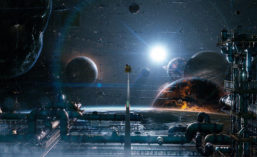
On Space Ballistics, Part I

Let’s talk about ammo for a second. Specifically, ammo in space. Most visions of the future of warfare in space envision massive ships moving slowly and shooting lasers and explosive torpedoes at each other from relatively close distances. The actual likelihood of a lot of that is difficult to predict because so much of it depends upon things like the resources available to the military forces, the nature of faster than light (FTL) travel (i.e., are we talking wormhole style travel or just really fast linear travel?), and the nature of defensive technologies such as shields or armored hulls. Having said that, there are certain aspects of space warfare that we can predict given the nature of warfare in an environment such as deep space.

For one, space is frictionless (or nearly so). So much of the warfare that has been undertaken in human history between large ships has involved projectiles that were designed to deal with the challenges of flight through an atmosphere full of friction. This necessarily meant that the velocity of any projectile would begin diminishing from the moment it stopped accelerating. This meant that purely kinetic projectiles like cannonballs immediately began losing effectiveness the moment it left the barrel of the cannon. More modern projectiles attempted to make up for this loss in effectiveness by adding explosives to the projectile.

In a frictionless environment, however, there would be no appreciable loss in velocity, even over vast distances. As a result, the impact velocities that could be achieved in space warfare would vastly exceed those achieved in atmospheric warfare. In such a case, explosive projectiles would be unnecessary, and warfare would return to the days of solid, purely kinetic projectiles. Imagine a weapon that could launch a solid projectile the size of say, a Buick, at a velocity beginning to approach the speed of light. Such a projectile could punch a hole through almost anything, and it is hard to imagine any kind of shield or armor that could withstand such a punch.

Furthermore, in a frictionless environment, the projectile would not lose velocity even at vast distances. As such, spacecraft would likely conduct their warfare at massive distances. Light travels at over 186,000 miles per second. That means that with weapons that could launch projectiles at such massive speeds, the moon could conceivably get into a shooting war with the Earth and not have to involve the travel of warships, but could actually just shoot at each other directly, with impact occurring a mere second and a half after firing. Of course, in this horrific case, projectiles impacting the Earth and moon at such high velocities would likely lead to extinction level events on both celestial bodies.

Of course, launching any projectile at near the speed of light is far easier said than done. The energy necessary to achieve that kind of velocity is literally incredible. The suggestion of such a weapon is not meant to predict that weapons of the future will achieve that kind of velocity. Rather it is to demonstrate the extreme point of the overall intention of this article, which is that extremely high velocity projectile weapons are more likely to be effectively adopted in space warfare than energy based weapons like lasers, or explosive weapons like torpedoes. Present day technology is capable of launching a projectile, in atmosphere, at around 5,000 miles per hour (see the US Navy’s new rail gun technology). It is not outside the realm of possibility to suggest that by the time we achieve FTL travel, would will also be able to hurl a solid object at one hundred or even one thousand times that speed through space.  The destructive power of such a weapon would be incredible. Perhaps paralleled only by its implications on society…

Pelagians and Space Warfare

The Pelagians are a race of sentient aquatic animals coming from the planet Pelagia. Pelagians typically boast eight invertebrate limbs, causing some on Earth to equate them with squids or octopuses. However, apart from the limbs which help visually define Pelagians, they actually carry an extensive skeletal structure within their torso and skull regions. Respective to human anatomy, Pelagians exhibit a much greater proportion of their torsos and skulls. Having said that, when a Pelagian is “standing” on solid ground next to a human, it appears to be much shorter as it tends not to stand as tall on its limbs in standard gravity as a human does.

What distinguishes Pelagians from other space fairing creatures the most, however, has not been their physical differences so much as the affect they have had on space warfare and other out-of-atmosphere military engagements.

By way of background, it is important to note that the pelagians required a relatively long time to develop space flight as compared to the other species of space. This is due in no small part to their aquatic nature, which requires their spacecrafts to be filled with the much heavier water, as opposed to the various gaseous atmospheres required in other ships. This, combined with the sub-aquatic natures of the launch pads used by early pelagian spacecraft, vastly complicated the necessary systems to achieve early space flight. As a direct result, pelagian societies were necessarily further developed at the moment they achieved space flight as compared to the other species of space at the same moment.

The degree to which this fact influenced Pelagian strategic advancement, however, remains a subject of debate. Some scholars argue that the extra time required to develop space flight allowed pelagian military strategists more time to develop their craft and develop strategies not seen on other planets or in other military encounters.

Other scholars, however, point to a more evolutionary influence on pelagian military strategy. These scholars argue that given the purely aquatic evolution of the pelagian species, they developed a more natural understanding of military strategy in a three dimensional environment. This lead to a military strategy more initially suited to out-0f-atmosphere engagements.

Regardless of the cause, it is generally agreed that early Pelagian military strategies (as exhibited in their first engagements with Sapien Colonial forces and later with expeditionary forces under the command of the Unified Human Military Command) were surprisingly advanced for such an ostensibly less technologically advanced military force.

We say ostensibly inferior technology because, despite clear inferiority to human spacecraft on a number of rather basic levels (propulsion systems, sensors, firepower, etc.) Pelagian military spacecraft enjoyed a number of technological advantages over their human counterparts that directly led to a number of their early victories (and indeed advantages that continue to hold true today).

Foremost among these advantages is the very basic fact that pelagian spacecraft are filled with water. This means that Pelagian craft are, by necessity, many times denser than other spacecraft. The weapons employed by the human forces in the early engagements with Pelagian forces were designed to pierce the hulls of far less dense objects at high velocity. As a result, the projectiles from these weapons had a tendency to ricochet off the Pelagian ships or, in the case of more direct hits, would be more quickly absorbed and, ultimately, do far less damage than would otherwise be expected. It was not until more advanced analyses of the battles were undertaken and better intelligence gathered that human military forces began using the “old fashioned” yet more effective concussive weaponry against Pelagian forces.

Nonetheless, Pelagian military forces continue to enjoy impressive advancements on a number of fronts, and Pelagian military strategists continue to surprise, confound and challenge their adversaries to this day. As such, Pelagian military forces have come to be some of the most feared and respected military forces in the known universe.

Grizzled and Angry

He was old, but that hadn’t slowed him down any. He still drank and smoked and swore every day that it would be the death of him. He worked harder than any of those damn kids they kept hiring at the factory, and he made sure everyone knew it. They would have rolled their eyes more at his complete lack of modesty if he didn’t actually have a point.

He worked overnights at the factory. They had put him on the inserter a few years back, mostly because he didn’t get along with any of those damn kids they kept hiring, and the inserter was the only machine that allowed him to work alone. Most of the time, anyway. It was okay, he didn’t mind having the shift to himself.

What he did mind was how often that fucking machine kept breaking down. He was constantly fixing the damn thing. Constantly swearing at it while he did. “Pillow biter” was his favorite curse, although his years lumberjacking as a kid had given him quite the swearing vocabulary, even if it had come at the cost of a few fingers.

He was getting close to retirement age, but he was never going to retire. Frankly, he was surprised he had lived this long. Two wives hadn’t killed him, neither had a couple of stints in jail, nor a bought of cancer a few years back. Bacon and cigarettes were his preferred breakfast, a thirty pack of Bud his preferred dinner. Truth is, at this point he’d probably live to a hundred, and die with his hands elbow deep in the inserter, mouth spewing an elegantly strung line of swears.

The Bartender – 1

BartenderHere’s the point when it comes to bartenders: Think of the most optimistic you can be about humanity. I mean those moments, maybe right after sex, or just after you got married, or just after you got hired to your dream job. I’m talking, the best you can possibly imagine humanity can be. And in that moment of pure bliss and utter optimism about your fellow man, assign a percentage of people who are just complete assholes.

When I say assholes, I mean, genuinely and without any doubt, the type of person that is nothing but pure, unadulterated incivility. In that moment, when we are at our most optimistic about humanity, the type of person who would make our bottom, say, five percent of humanity. The people who are just awful human beings at every moment, or worse the people who are generally good but just lose their mind for a moment because, well, life is hard and sometimes we do that.

In a given night, a bartender interacts with at least one hundred people. On most normal nights the number is higher than that, and on busy nights the number is several hundred. That means that, statistically speaking, a bartender has to deal with the bottom five percent of humanity at least a half dozen to several dozen times, every time they go to work.

Most people deal with the same one or two dozen people when they go to work every day. Granted, some of those two dozen people can have bad days or generally be bad people. While the statistical probability that one of those two dozen people will rank amongst the bottom five percent of humanity is relatively high (a one in twenty chance that someone within a group of twenty four will rank in the bottom five percent means a virtual inevitability that at least one person within the group will be terrible), it is generally the same person that achieves this rank every day. As such we learn to avoid that particular person, or forgive the people that are clearly just having a bad day. The bartender has no such luxury, and even if he did has to deal with at least five times as many terrible people every day.

Given this statistical inevitability, it should come as no surprise that bartenders become jaded and hateful towards their fellow human. After all, by our math, bartenders have to deal with five times as many terrible people each day as the normal person. What should be the greater surprise is that they are capable of remaining civil at all.

This bartender is one of those rare breeds that has, from the beginning, rejected the bitter bartender approach. It certainly helps that he is surrounded by alcohol at all times, both during and after his shift. Ultimately, however, it comes down to a choice that he makes. There are bartenders around him that have access to all the same alcohol to which he can drink, but choose to remain bitter about the assholes with which they deal on a daily basis. In the end, choice is a freedom we all enjoy, regardless of our influences. Choice is our most individual freedom, and we all exercise it on a constant basis. The question is not how often we make choices, but how wisely we make them.

The Old Traveler

He was the type of guy that always had a maitre’d that called him “Sir” and a hand of girls that called him “Candy”. When he was a kid he always had fathers and brothers chasing him like dogs in the street, but now he was smart enough to never let them know he existed in the first place. He didn’t have any kids, but there were a few anonymous payments sent to anonymous people in even more anonymous countries. He could blend in anywhere, but he preferred to stand out everywhere. He always seemed to have a place to stay and a neighborhood to avoid. He was missing a toe from days gone bad, but the only ones who knew about those bad days or the bad toe had forgotten to leave Saigon when the leaving was, well, good. He spoke French at sunset, Spanish at night, and German in the morning. If he’d been around for the fall of Rome he would have simply shrugged and walked to Paris. There was a kid once, followed him around Bangkok back when the place was seedy and still had secrets, watched him drink gin and tonic and said, “You kind of like James Bond, but you an asshole. I like you,” then the kid walked to another bar and made some friends, never to return.